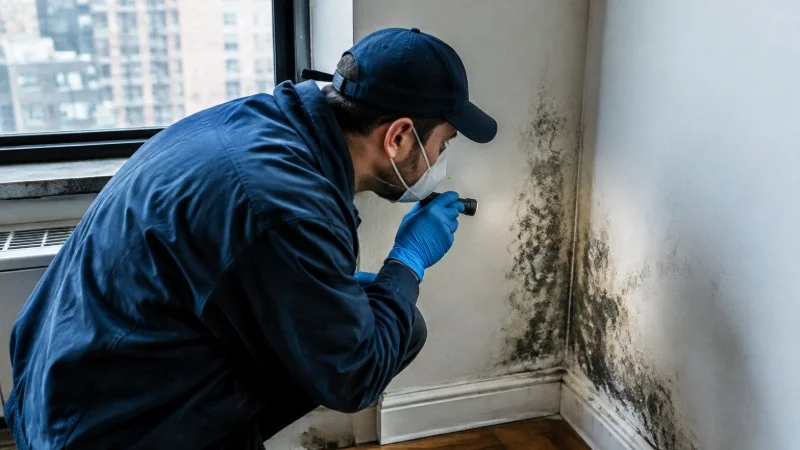
Mold can make a Brooklyn apartment legally unlivable. That’s not a scare line; it’s how the Housing Maintenance Code reads. If you own a few rental units in Bed-Stuy, Flatbush, or Crown Heights and an HPD notice just landed in your mailbox, the clock started the day the inspector wrote it up.
Here’s what most small landlords miss. HPD doesn’t care how the mold got there or whether the tenant caused it. It cares about the correction date. Miss that date—you’re looking at civil penalties, a possible court case, and in the worst scenarios, repairs done by the city and billed straight to you. HPD mold violation remediation NYC isn’t a vague maintenance chore (it’s a legal process with specific steps). And it’s tighter in 2026 than many owners assume.
So can mold really push a unit past the habitability line? Sometimes, yes. The harder question is what HPD expects from you once it does.
When Mold Crosses the Line: What Makes a Brooklyn Apartment Legally Uninhabitable
A tenant in a Crown Heights walk-up calls 311 about black growth spreading across a bathroom ceiling. Two weeks later, an HPD inspector measures it at 14 square feet. The landlord, who owns four units, now has a Class C violation and a short clock. That’s how fast it moves.
How Habitability Is Defined Under NYC Housing Maintenance Code
Habitability isn’t a vague idea here. The Housing Maintenance Code says every unit must be free of conditions that hurt a tenant’s life, health, or safety, and mold tied to leaks or damp walls falls squarely inside that. Inspectors don’t need a lab report to cite it. They need eyes and a tape measure.
In practice, the violation class tells you how serious it is. Class A is non-hazardous, Class B is hazardous, and Class C is immediately hazardous. Mold usually lands in B or C.
Why Mold Over 10 Square Feet Changes Everything for Landlords
Ten square feet is the line. Under Local Law 55, mold covering that much area is treated as a larger problem, and the fix needs more than a bleach spray and a fresh coat of paint. Here’s what changes:
- Licensed work: a certified assessor and a licensed contractor usually have to be involved.
- Protocol: containment, a written plan, and post-work clearance testing.
- Paper trail: a certificate of correction filed with HPD, not just a verbal promise.
Skip a step and the violation stays open. Penalties keep climbing, and a tenant can bring a habitability case. Landlords who need HPD mold violation remediation NYC handled properly should fix the moisture source first. Otherwise, the mold returns.
From Complaint to Violation: How HPD Responds to Mold in Brooklyn Rentals
HPD doesn’t wait for a lawsuit. One tenant call to 311 in Bushwick or Crown Heights sends an inspector to the unit, usually within a few weeks, and if they see mold, you get a violation on record.
That’s when HPD mold violation remediation NYC becomes your problem, with a clock attached. The inspector measures the affected area, finds the moisture source, and writes it up under the housing maintenance code.
Class A, B, and C Violations and What Each Deadline Means
The class sets your deadline. Mold over 10 square feet, or tied to a leak you haven’t fixed, usually lands in the higher tiers. Here’s the breakdown:
- Class A (non-hazardous): 90 days to correct.
- Class B (hazardous): 30 days to correct.
- Class C (immediately hazardous): 24 hours for most, and some get 21 days.
Fix the leak first. Mold comes back if the water source stays.
What Happens When the Correction Date Passes: Penalties and Escalation
Miss it, and the cost climbs fast.
Civil penalties run roughly $10 to $100 per day on Class B, and up to $250 on Class C, depending on the building. HPD can also send its own contractor and bill you, with the charge landing as a lien on the property.
Worse, a tenant can file a Housing Court case for repairs, and the court can order work and add penalties. Ignored violations also stack up on the building’s record, which matters at refinance or sale.
So what should you do? Hire a licensed contractor, keep the testing results and photos, and certify the correction with HPD before the deadline. Paperwork wins here.
What Compliant HPD Mold Violation Remediation in NYC Actually Requires
Think a bleach wipe-down will close the violation? It won’t. Brooklyn landlords learn that the hard way when an HPD inspector comes back, and the mold is still there.
Licensed Assessors, Remediators, and the Local Law 55 Protocol
Local Law 55 sets the rules for indoor allergen hazards, and mold sits at the center. Any area over 10 square feet needs a New York State licensed assessor and a separate licensed remediator. Same company doing both? That’s a conflict of interest the state doesn’t allow. Get a written plan first. Then the work starts.
Fixing the Moisture Source First (Or the Violation Comes Back)
Mold is a symptom. In a Bronx or Brooklyn walk-up, the cause is usually a leaking riser, a bad roof seam, or a window that never sealed right.
- Find the leak and repair it before any cleanup.
- Dry wet materials down to normal moisture readings.
- Replace drywall that can’t be saved. Don’t just paint over it.
Skip this step and you’re paying twice.
Clearance Testing, Documentation, and Certifying Correction to HPD
Once the contractor finishes, the assessor runs clearance testing (air samples, a visual check, moisture readings). Only a passing result counts.
- Keep the assessment, remediation plan, and lab results.
- Save invoices and the contractor’s license numbers.
- Certify correction to HPD by the deadline on the notice.
HPD can reinspect, and false certification brings penalties. So keep every page of paperwork.
Landlord Next Steps This Week: Deadlines, Insurance Coverage, and Avoiding False Certification Risk
Nearly half of small Brooklyn landlords who get a mold notice call a contractor before they read their own policy. That’s backward. For HPD mold violation remediation in NYC, the order of operations decides who pays.
Start with the notice itself. Check the violation class and the correction date. Then make three calls this week: your insurer, a licensed mold assessor, and a certified restoration contractor.
Checking Your Policy and Talking to Your Adjuster Before Work Starts
Pull the policy. Look for water damage coverage, mold sublimits — exclusions for long-term seepage (many policies cap mold at $10,000 or less, or exclude it outright).
Report the loss before demolition starts. Adjusters want to see damage, take photos, and approve scope. Tear out drywall first, and you may lose the claim. Coverage depends on your policy, so don’t assume anything is paid.
- Photograph every affected wall and ceiling.
- Keep the HPD notice and all inspection dates.
- Get a written estimate that your adjuster can review.
Why Rushing a Certificate of Correction Can Cost More Than the Original Violation
Filing a false certification isn’t a paperwork slip. It can bring civil penalties and a reinspection that finds the mold still there. Tenants can dispute it, and HPD can reopen the case.
Don’t certify until a post-remediation test clears the space.
Keep the lab report and the contractor’s work records on file. That’s your proof.
A Brooklyn apartment doesn’t need to look like a disaster to become a legal problem. Mold over 10 square feet, or mold tied to a leak nobody fixed, can turn a routine repair into a violation with a clock on it. And that clock doesn’t stop for slow contractors or slow insurers.
The pattern is simple. Find the water first. Hire licensed pros who follow the Local Law 55 protocol. Get clearance testing in writing. Skip any step, and the violation often returns, sometimes with a false-certification problem attached (which costs far more than the original notice).
That’s why HPD mold violation remediation NYC works best as a sequence, not a scramble. Each piece feeds the next, and the paperwork is part of the job, not an afterthought.
So here’s the move for this week. Pull out the violation notice and circle the correction date. Call your insurance carrier before any work begins, and ask what documentation the adjuster wants. Then book a licensed assessor to scope the unit and trace the moisture source. Do those three things in that order, and you’re protecting both the tenant and your own file.